
Eddy current separation, density separation, sensor-based sorting… There are several methods for separating non-ferrous metals in recycling plants. These technologies make it possible to recover mixed non-ferrous metal fractions and subsequently separate specific materials, such as aluminium, copper, brass and zinc, to obtain products with higher purity and commercial value.
The key is to select and combine the appropriate separation stages and technologies based on the characteristics of the input material, recovery targets and final product specifications.
Waste streams can contain non-ferrous metals such as aluminium, zinc and copper, as well as alloys such as brass. Separating these materials is a fundamental stage in the recycling process and serves two main purposes: first, recovering and concentrating non-ferrous metals into a mixed fraction and, subsequently, sorting that mixture into individual metals or specific grades to increase their purity and commercial value.
To achieve this, recycling plants combine different separation technologies depending on the composition of the input material, particle size and final product quality requirements. The choice of method depends on whether the objective is to recover a mixed non-ferrous metal fraction or to separate specific materials with greater precision.
The recycling process typically begins with the treatment of a waste stream, such as waste electrical and electronic equipment (WEEE), end-of-life vehicles, slags or industrial waste, to liberate and concentrate metals while removing unwanted materials. Before applying advanced non-ferrous metal separation technologies, the feed must be properly conditioned through several preparation stages.
The material undergoes shredding and fragmentation processes to liberate non-ferrous metals from other materials and break apart particles that remain attached to one another. Once a sufficient degree of liberation has been achieved, the material is screened into more uniform particle size fractions, improving the efficiency of subsequent separation stages.
Ferrous metals are removed using magnetic separators, reducing contamination in the material stream and facilitating the subsequent recovery of non-ferrous metals. The result is a feed stream better prepared for the following separation and sorting stages.
Sensor-based sorting technologies require a stable and uniform feed. Controlling moisture is therefore essential, as wet material can cause particles to clump together, interfere with detection and reduce separation efficiency.
In addition, the material must fall within the appropriate particle size range for the technology being used and be evenly distributed across the conveyor belt, preferably in a single layer.
Once the material has been properly conditioned, the process can continue with the recovery of a mixed non-ferrous metal fraction, followed by sorting into individual metals or specific grades. The general sequence therefore includes liberation and sizing, ferrous metal removal, non-ferrous metal recovery and, finally, the sorting of target metal fractions. The order and combination of these stages depend on the characteristics of the input material and the final product specifications.
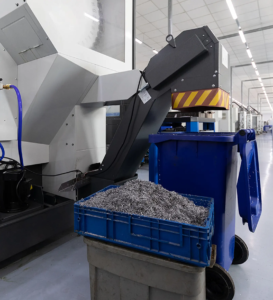
Metal processing equipment with a container of metal scrap in an industrial recycling facility
Different technologies can be used to recover a mixed non-ferrous metal fraction containing various metals and alloys. Among these, eddy current separation is one of the methods used to recover conductive materials from previously prepared waste streams.
To recover non-ferrous metals based on their electrical conductivity, an eddy current separator uses a high-speed magnetic rotor that generates a changing magnetic field.
When a conductive metal particle passes through this field, circulating electrical currents, known as eddy currents, are induced within it. These currents generate their own magnetic field which, according to Lenz’s law, opposes the change in magnetic flux that produced them.
As a result, an electromagnetic force deflects the metal particle from its natural trajectory. This phenomenon allows non-ferrous metals such as aluminium, copper and brass to be projected further than non-conductive materials, enabling their physical separation into different streams.
The strength of this force and the trajectory of the particles depend on factors such as electrical conductivity, particle size, mass and geometry.
Electrical conductivity, density, particle size and shape all influence the effectiveness of eddy current separation. More conductive metals can generate stronger induced currents and experience a greater electromagnetic force. However, the final trajectory of each particle is also influenced by its mass and density, as the same force will produce a different deflection in a lightweight aluminium particle than in a heavier copper or brass particle.
Similarly, particle size and geometry affect the magnitude of the induced currents and the behaviour of particles during ejection.
Due to the interaction of these factors, an eddy current separator does not identify or sort metals according to their chemical composition. Its primary function is to separate conductive materials from non-conductive ones, meaning that the recovered metal fraction may contain different metals and alloys.
When the objective is to obtain specific fractions of aluminium, copper, brass or other non-ferrous metals with higher purity levels, this stage must be complemented by additional sorting technologies.
Both methods can improve the concentration and purity of certain material streams by exploiting different physical properties to separate their components. However, these technologies are not mandatory stages in every recycling line. Their use depends on the composition of the input material, particle size, recovery targets and the quality specifications required for the final product.
Density separation exploits differences in the specific density of materials to obtain more homogeneous streams. Following shredding, liberation, screening and the removal of unwanted materials, the mixture passes through density separation systems that distinguish between lighter and heavier materials.
This technology can be used to concentrate certain metal fractions before applying more advanced sorting systems, or as a more cost-effective alternative when highly selective separation is not required.
However, its effectiveness depends on the material having a relatively uniform particle size distribution and an adequate degree of liberation. When materials have similar densities or contain composite particles, separation quality decreases.
Electrostatic separation exploits differences in electrical conductivity and how materials behave in electric fields to separate conductive particles from non-conductive ones. During the process, particles follow different trajectories depending on their electrical properties, allowing metals to be separated from plastics, rubber, fibres and other non-metallic materials.
This technology is particularly useful for previously conditioned fine fractions, where other mechanical systems may have limitations. It can be used as a complementary stage to increase metal recovery from fine granulates, especially in applications such as cable recycling or electronic waste recycling.
However, it requires careful control of particle size, very low moisture levels and uniform feeding. Electrostatic separation can also be used to distinguish between certain metallic and non-metallic materials, although its effectiveness depends on the electrical properties of each material, particle size and geometry.
In practice, both density and electrostatic separation can be used to improve material concentration before final sorting or to recover metals from specific streams. When high-purity products or the separation of individual metals such as copper, brass, aluminium or stainless steel are required, these stages can be complemented by sensor-based sorting technologies.
To improve the quality of mixed non-ferrous metal fractions, sensor-based non-ferrous metal sorting solutions can automatically identify and separate materials according to their physical or chemical properties. Unlike methods designed to recover a mixed metal fraction, these systems can sort its components into specific fractions with higher purity levels and commercial value.
The choice of technology depends on the metals to be recovered, the characteristics of the input stream and the quality requirements of the final product.
Zorba is a mixture of non-ferrous metals recovered through mechanical separation processes, consisting mainly of aluminium, along with copper, brass, zinc and other metals and alloys.
Sensor-based Zorba sorting makes it possible to separate the different components of this heterogeneous mixture and obtain more homogeneous, higher-purity metal streams. This enables recycling plants to recover specific fractions that better meet buyers’ quality requirements, improving resource recovery and the economic value of recycled materials.
To achieve this, it is necessary to select technologies capable of identifying the properties that distinguish the materials present in the mixture, taking into account particle size, composition and separation targets.
Sensor-based sorting technologies use different detection principles to identify materials and separate them according to their characteristics.
RGB sensors distinguish materials by colour and appearance, while induction sensors detect the electrical properties of metal particles. Both technologies can be used for metal sorting tasks, depending on the characteristics of the material and the separation objective.
Elemental analysis technologies, such as XRF (X-ray fluorescence) and LIBS (laser-induced breakdown spectroscopy), provide information about the elemental composition of materials, enabling the identification of certain metals and alloys. Other technologies, such as XRT (X-ray transmission), distinguish materials based on their X-ray attenuation properties.
Each technology has different capabilities and limitations, so the choice must reflect the characteristics of the input stream, particle size and the required purity and recovery levels. In certain processes, combining different sensors makes it possible to address sorting tasks that could not be performed as effectively using a single technology.
Selecting and validating a metal separation process requires a thorough understanding of the input material, as well as the target metal fraction, the required purity specifications and the plant’s processing capacity.
To determine the most suitable technology, material recovery, achievable purity and system throughput must be evaluated together. Validation requires testing representative samples to assess these parameters and process stability before implementation on an industrial scale.
| Stage | Input Material | Target Fraction | Constraints and Limitations | Required Tests |
|---|---|---|---|---|
| Material characterisation | Mixed non-ferrous metals, Zorba, cable granulate, slags or bottom ash | Recoverable metals at the required purity level | Variable composition, contamination and degree of liberation | Particle size analysis, chemical composition analysis and representative sampling |
| Preparation and conditioning | Shredded or mixed material | Fraction suitable for sorting | Unsuitable particle size, presence of fines or moisture | Screening trials, size separation and liberation assessment |
| Technology selection | Prepared fraction | Aluminium, copper, brass, stainless steel or other alloys | Detection limitations depending on material size, shape and composition | Sorting trials using representative sensor technologies |
| Process optimisation | Pre-sorted material streams | Maximised recovery and purity | Balance between recovery, product quality and processing capacity | Parameter adjustments and pilot trials |
| Industrial validation | Representative material under full-scale conditions | Commercial product meeting quality specifications | Operational variability, changes in feed material and required plant capacity | Continuous performance, purity, recovery and throughput testing |
In conclusion, non-ferrous metal separation for recycling requires selecting and combining technologies suited to the characteristics of the input material and the quality objectives of the final product. This involves considering the composition of the material stream, particle size and degree of liberation, as well as the required purity, recovery and processing capacity. Testing representative material makes it possible to assess the performance of the selected solutions before implementation on an industrial scale.
In this context, the ELDAN MPS sensor-based sorting system enables the automatic sorting and separation of different types of non-ferrous metals using advanced detection technologies. Its flexible configuration allows it to adapt to different sorting tasks and the characteristics of the materials being processed. ELDAN Sorting’s MPS models feature acceleration conveyor belts ranging from 1,000 to 3,000 mm in width and different separation configurations, including double-bar and multi-track options, depending on the requirements of each application.
Testing representative samples is essential to confirm that the selected technology can simultaneously meet the required recovery, purity and processing capacity targets. If you would like to test your material with Eldan at ELDAN Sorting’s facilities, you can contact our team to arrange a visit.